A Technical Perspective from Repeated Signal Solutions (RSS)
The Market Shift Reshaping Urban Real Estate
Across North America and Europe, office-to-residential conversion has moved from a niche strategy to a defining trend in urban development. Hybrid work has permanently reduced demand for traditional office space, while housing shortages in major cities continue to intensify. In response, developers are repurposing underutilized office assets into multifamily housing, condominiums, and mixed-use residential environments.
Adaptive reuse offers clear advantages—preserving structural assets, reducing construction timelines, and significantly lowering embodied carbon compared to ground-up development. But the reality is far more complex than a simple interior renovation.
Office buildings were never designed to function as residential environments. Their geometry, infrastructure, and systems were built for entirely different patterns of occupancy. As a result, conversion projects fundamentally reshape everything from mechanical systems to vertical circulation—and increasingly, wireless connectivity.
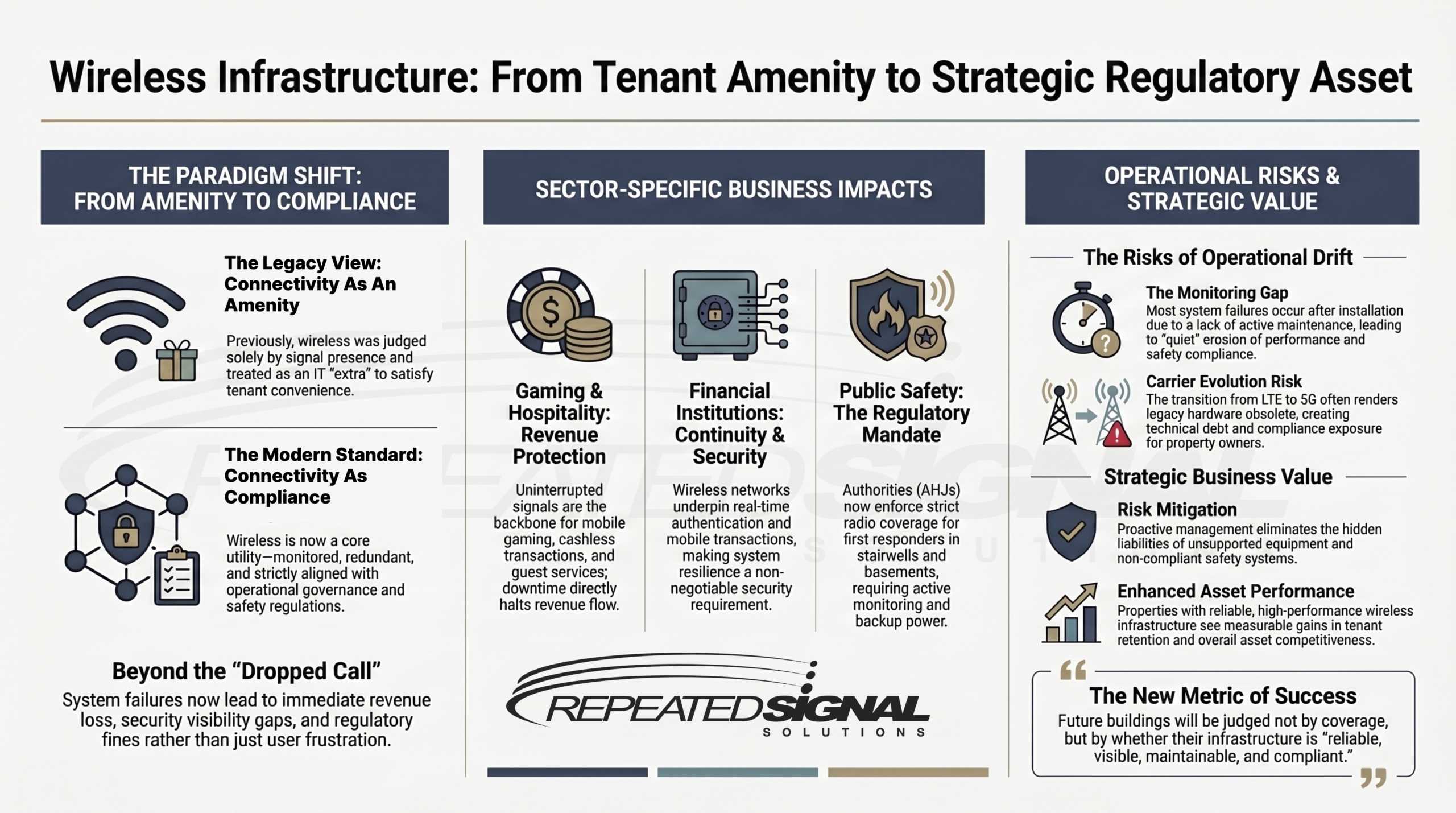
Today, cellular coverage, Wi-Fi performance, and public safety radio systems are no longer secondary considerations. They are core building utilities, directly impacting leasing velocity, tenant satisfaction, operational performance, and life-safety compliance.
This is where specialized engineering becomes critical—and where RSS operates as a technical authority.
The Geometry Problem: Why Office Buildings Don’t Translate Cleanly to Residential
One of the most immediate challenges in adaptive reuse is building geometry.
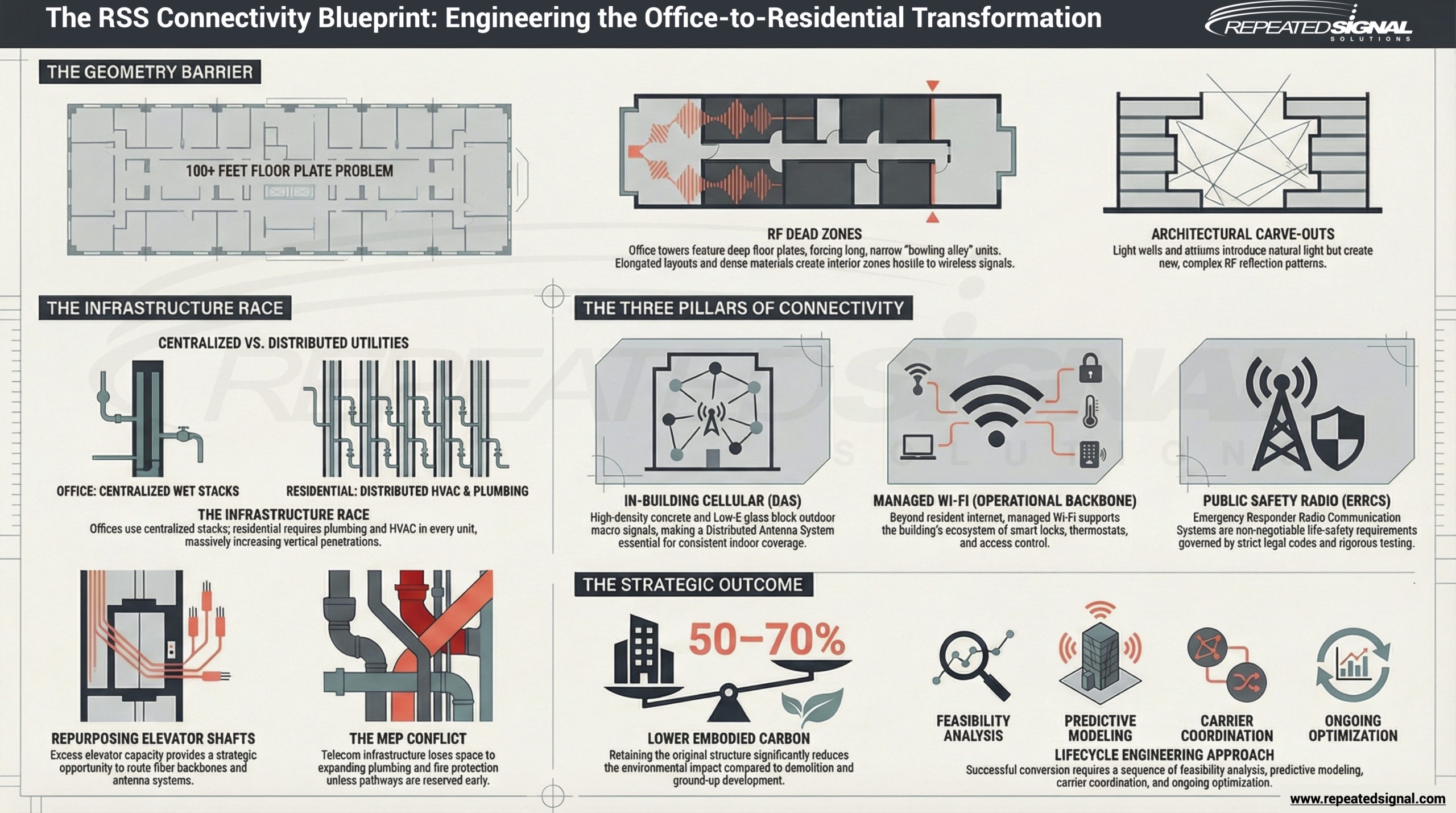
Office towers often feature deep floor plates—frequently exceeding 100 feet from façade to core. While this works for office layouts, residential code requirements demand natural light, ventilation, and egress for living spaces. The result is a design constraint that reshapes the entire building.
This leads to the well-known “bowling alley” unit—long, narrow apartments with a single window exposure. These layouts not only compromise livability but create deep interior zones that are inherently hostile to wireless performance.
From an RF perspective, these interior spaces become predictable dead zones. Cellular signals attenuate rapidly through concrete and Low-E glass, and Wi-Fi struggles to maintain consistent coverage across elongated layouts.
To address this, developers increasingly introduce architectural carve-outs—light wells, atriums, and internal courtyards—to create additional façade exposure. While effective from a daylight standpoint, these interventions significantly alter RF propagation behavior, introducing new reflection patterns, vertical signal paths, and antenna placement challenges.
This is why wireless infrastructure design cannot rely on original office drawings. It must be engineered against the final residential layout.
Vertical Infrastructure: The Hidden Opportunity—and Constraint
Office buildings are designed around peak occupancy flows, which typically results in an overabundance of elevator capacity when converted to residential use.
This creates a strategic opportunity: unused elevator shafts can be repurposed into high-value vertical infrastructure pathways.
For RSS, these reclaimed shafts are among the most critical assets in a conversion project. They enable the routing of fiber backbone, distributed antenna systems, public safety radio pathways, and power infrastructure—systems that are otherwise extremely difficult to retrofit into existing structures.
However, this opportunity only exists if identified early. If vertical pathways are not reserved during planning, they are quickly consumed by competing systems.
The MEP Conflict: Why Telecom Often Loses
The transition from office to residential dramatically increases mechanical and plumbing complexity.
Office buildings typically rely on centralized wet stacks. Residential buildings require kitchens, bathrooms, and laundry in every unit. This multiplies vertical penetrations and introduces significant constraints—especially in post-tension slab construction, where drilling can compromise structural integrity.
As plumbing, HVAC, electrical, and fire protection systems expand, they compete aggressively for limited pathway space.
Without early coordination, telecom infrastructure—including cellular DAS, Wi-Fi backbone, and public safety radio—often becomes an afterthought. The consequences are predictable: blocked risers, visible antennas, redesign costs, and compromised performance.
This “vertical infrastructure race” is one of the most common failure points in adaptive reuse projects.
Connectivity Is Now a Core Building Utility
In modern residential environments, connectivity is no longer a convenience—it is an expectation.
Residents expect seamless performance across every space: bedrooms, kitchens, elevators, parking structures, amenity areas, and outdoor environments. Delivering this requires three distinct but coordinated systems:
- Carrier-grade cellular infrastructure
- Managed Wi-Fi networks
- Public safety radio systems (ERRCS)
Each system serves a different purpose. None can substitute for the others.
Cellular Infrastructure: Why Outdoor Signal Is Not Enough
Converted buildings are particularly challenging for indoor cellular performance.
Materials such as Low-E glass and dense concrete significantly reduce signal penetration from outdoor macro networks. Combined with deep floor plates and dense unit layouts, this creates inconsistent and unreliable coverage.
The typical resident experience becomes fragmented—strong signal near windows, degraded performance deeper inside units, and dropped calls in critical areas.
The only reliable solution is engineered in-building cellular infrastructure, typically in the form of a Distributed Antenna System (DAS) or small-cell network. These systems must be designed, modeled, and aligned with carrier requirements from the outset.
Without this, buildings risk becoming “connected in theory, disconnected in reality.”
Wi-Fi Strategy: From Amenity to Operational Backbone
Wi-Fi in residential environments has evolved far beyond basic internet access.
Modern buildings rely on wireless infrastructure to support an entire ecosystem of connected systems—smart locks, sensors, thermostats, cameras, access control, and building operations platforms.
Uncoordinated, resident-installed routers create interference and inconsistent performance. In contrast, properly designed managed Wi-Fi networks provide predictable coverage, controlled spectrum use, and support for both resident connectivity and building systems.
For developers, Wi-Fi is no longer just an amenity—it is an operational platform.
Public Safety Radio (ERRCS): A Non-Negotiable System
Public safety radio systems are among the most critical—and most misunderstood—components of adaptive reuse.
When first responder radio signals cannot reliably penetrate a building, jurisdictions require the installation of Emergency Responder Radio Communication Systems (ERRCS).
These systems are governed by strict codes and standards, requiring redundancy, survivability, monitoring, and rigorous acceptance testing.
In conversion projects, structural changes often degrade existing radio conditions, triggering new compliance requirements. Failure to address this early can delay occupancy and create significant rework.
ERRCS is not optional infrastructure—it is a life-safety system that must be engineered with the same rigor as fire protection or structural systems.
Sustainability and the 2026 Climate Mandate
Adaptive reuse is increasingly driven by sustainability goals.
By retaining structural elements such as foundations, frames, and slabs, developers can significantly reduce embodied carbon—often by 50–70% compared to demolition and new construction.
This aligns with evolving ESG mandates, green financing programs, and emerging standards such as the 2026 Green Communities Criteria.
However, sustainability does not eliminate the need for modern infrastructure. In fact, it increases the importance of integrating high-performance systems into existing buildings.
The RSS Approach: Integrated, Early, and Carrier-Aligned
Successful office-to-residential conversions require more than design coordination—they require a structured, engineering-led approach to connectivity.
At RSS, this process begins with early-stage feasibility analysis, evaluating building geometry, RF conditions, vertical pathways, and public safety requirements. From there, we develop an integrated basis of design that aligns cellular, Wi-Fi, and life-safety systems with architectural and MEP planning.
Detailed engineering follows, supported by predictive modeling, carrier coordination, and constructability validation. During deployment, RSS provides oversight through installation, testing, and commissioning—ensuring systems are not only built, but perform as intended.
This lifecycle approach continues beyond construction, with ongoing optimization and alignment to evolving carrier networks.
Conclusion: Infrastructure Determines Outcomes
Office-to-residential conversion is reshaping cities—but it is also exposing the limitations of legacy building infrastructure.
These projects are not simple renovations. They are full-system transformations that must address geometry, vertical infrastructure, mechanical constraints, and increasingly, wireless performance.
Connectivity and life-safety systems are now foundational to building success. When engineered early and integrated properly, they enhance performance, protect asset value, and deliver a consistent resident experience.
When addressed too late, they become one of the most expensive and disruptive problems a project can face.
Repeated Signal Solutions operates at the intersection of these challenges—bringing the engineering expertise, carrier alignment, and real-world execution required to deliver systems that work on day one, and continue to perform over the life of the asset.