In a world where connectivity is no longer a luxury but a fundamental business requirement, staying connected is paramount. Our Cellular Success Program is a comprehensive, end-to-end framework designed to ensure your cellular communication infrastructure is robust, reliable, and future-proof.
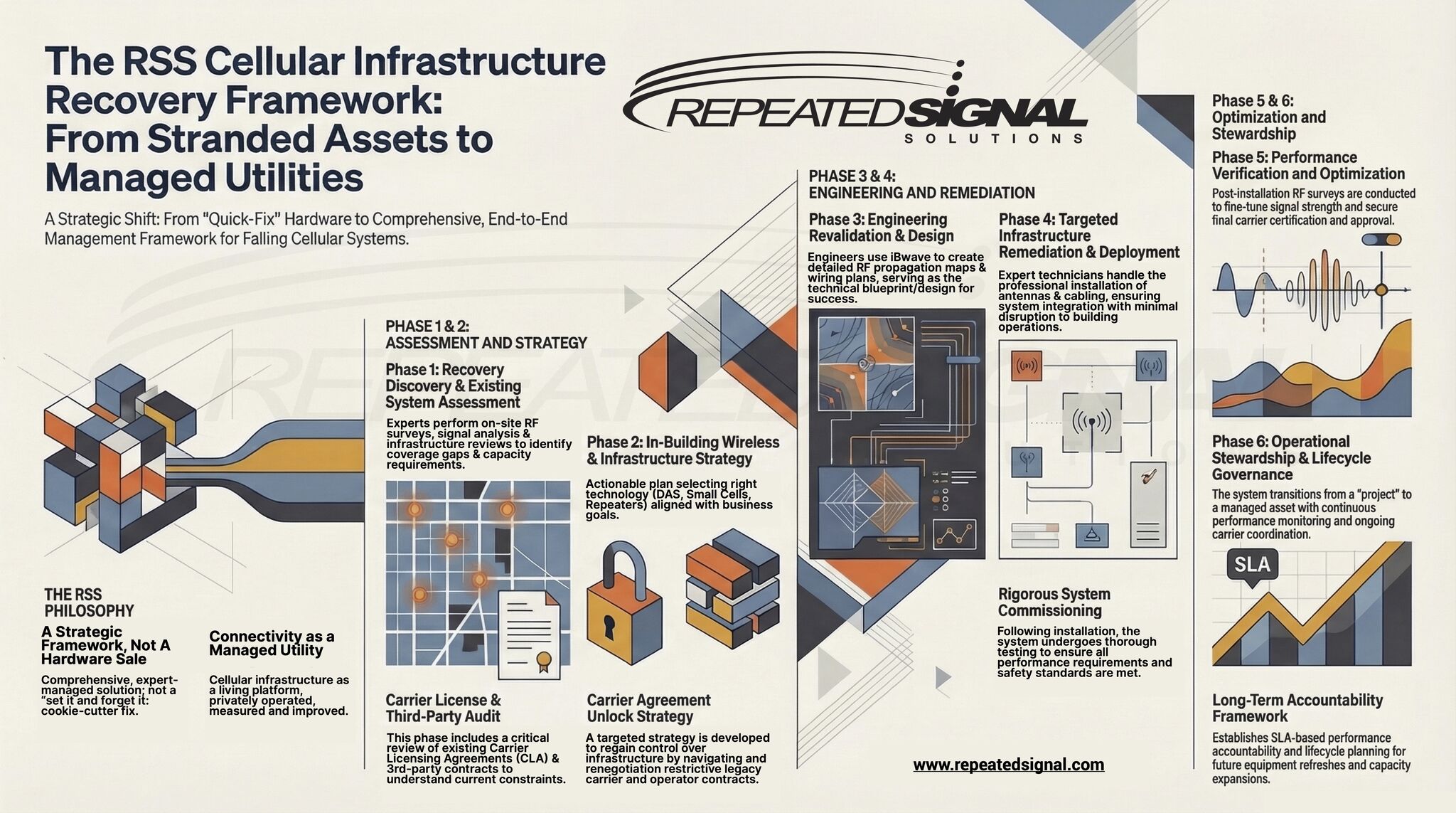
The RSS Cellular Infrastructure Recovery Framework
What the RSS DAS Recovery Program is:
- Comprehensive
- Strategic Focus
- End-to-End Solution
- Expert-Driven and Managed
What the RSS DAS Recovery Program is not:
- A quick fix approach
- Just a hardware sale
- A “Set it and forget it” model
- A siloed service
- Generic and cookie-cutter
Our process is divided into six (6) critical phases.
Each phase is meticulously designed to ensure your cellular communication infrastructure is not just functional but optimized for your specific needs and environment.
Phase 1: Recovery Discovery & Existing System Assessment
Success starts with a deep understanding of where you are and where you need to be.
This initial phase focuses on gathering the necessary intelligence to build a solid foundation for your communication strategy.
Key activities in this phase include:
- On-site RF Survey and Signal Analysis
- Building and Infrastructure Review
- Identifying coverage gaps and capacity requirements
- Review of Carrier License Agreements (CLA)
- Analysis of third-party company agreements (Boingo, American Tower, Extenet, Halo, etc.)
- Understanding current and future connectivity needs
“A comprehensive understanding of the existing RF environment is the first step toward a successful and reliable cellular solution.”
Objective: Identifying the current state of cellular coverage and performance. Through detailed on-site surveys and signal analysis, we identify gaps, interference, and areas of concern. This ensures that the proposed solution is tailored to your specific environment and requirements.
This phase includes a detailed review of the building’s layout, materials, and existing infrastructure to identify potential challenges and opportunities. It also involves an in-depth review of existing Carrier License Agreements (CLA) and an analysis of third-party company agreements, including those with providers like Boingo, American Tower, Extenet, Halo, and others.
The outcome of this phase is a detailed report that outlines your current RF landscape and provides a clear roadmap for the subsequent phases of the program.
Key Deliverables in Phase 1:
- Comprehensive RF Signal Strength and Quality Maps
- Detailed Infrastructure Assessment Report
- Carrier License and Third-Party Agreement Audit
- Identified Gaps and Recommended Course of Action
The Discovery and Assessment phase provides the data-driven insights necessary to build a truly effective and reliable cellular solution.
“A strategic approach to site selection and assessment ensures that your infrastructure is positioned for maximum impact and longevity.”
Next steps:
- Transition to In-Building Wireless Strategy
- Begin Vendor Selection and Evaluation
- Move toward a comprehensive cellular solution
Phase 2: In-Building Wireless & Infrastructure Strategy
A well-defined strategy is the cornerstone of any successful wireless project. In Phase 2, we translate the insights from the discovery phase into a comprehensive and actionable plan.
Key activities:
- Defining the scope and objectives of the project
- Identifying the most appropriate technology solutions (DAS, Small Cells, Repeaters, etc.)
- Developing a high-level design and architecture
- Carrier Agreement Unlock Strategy
- Vendor selection and evaluation
- Creating a detailed project timeline and budget
“A strategic wireless plan ensures that your technology investments are aligned with your long-term business goals and operational requirements.”
Carrier Agreement Unlock Strategy: This phase involves developing a targeted strategy to unlock the constraints of existing carrier agreements and third-party operator contracts (e.g., American Tower, Extenet, Boingo, Halo). Our goal is to regain control over your cellular infrastructure, enabling upgrades and performance improvements that were previously restricted by these legacy agreements.
This phase focuses on selecting the right technology and vendors to meet your specific needs. We evaluate multiple options, considering factors such as cost, performance, scalability, and ease of maintenance. Our objective is to design a solution that provides seamless coverage and capacity while minimizing disruption to your operations.
The In-Building Wireless Strategy also includes a detailed project plan, outlining the roles and responsibilities of all stakeholders, as well as a realistic timeline and budget.
Key Deliverables in Phase 2:
- Comprehensive Wireless Strategy Document
- Carrier Agreement Unlock and Renegotiation Roadmap
- High-Level System Architecture and Design
- Detailed Project Plan and Timeline
- Vendor Evaluation and Selection Recommendations
Phase 3 — Engineering Revalidation & Design (The Blueprint for Success)
With a solid strategy in place, we move into the detailed design and engineering phase. This is where the technical specifics of your cellular solution are finalized.
Key activities:
- Detailed RF Design and Propagation Modeling
- Equipment selection and specification
- Creating detailed installation and wiring plans
- Ensuring compliance with all relevant codes and standards
- Coordinating with cellular carriers
“A precise and well-engineered design is the foundation of a high-performance cellular communication system.”
Our team of experienced engineers uses state-of-the-art software to create detailed RF propagation maps, ensuring that antennas and equipment are placed optimally for maximum coverage and performance.
We also develop detailed wiring and installation plans, ensuring that the system is integrated seamlessly into your building’s existing infrastructure.
Key Deliverables in Phase 3:
- Detailed RF Propagation Maps and Designs
- Equipment Specifications and Bill of Materials
- Comprehensive Installation and Wiring Plans
- Carrier Coordination Documentation
Phase 4: Targeted Infrastructure Remediation & Deployment
This is the phase where the plan comes to life. Our team of expert technicians handles the installation and integration of your cellular communication systems.
Key activities:
- Professional installation of antennas, cabling, and equipment
- System integration and configuration
- Thorough testing and commissioning
- Adherence to all safety and quality standards
- Coordination with building management and other trades
“Professional installation and meticulous attention to detail are essential for ensuring the long-term reliability and performance of your cellular infrastructure.”
We manage every aspect of the deployment process, from running cable to mounting antennas and configuring equipment. Our team works closely with your building management and other trades to ensure that the installation is completed on time and with minimal disruption.
Once the system is installed, we perform a series of rigorous tests to ensure that it meets all performance requirements.
Key Deliverables in Phase 4:
- Professionally installed and integrated cellular system
- Comprehensive system configuration and setup
- Initial performance and connectivity test results
- As-built documentation and wiring diagrams
Phase 5: Performance Verification and Optimization
Once the system is installed, it’s critical to verify that it’s performing as intended. Phase 5 focuses on fine-tuning and optimizing your cellular communication systems.
Key activities:
- Comprehensive post-installation RF surveys and testing
- System optimization and performance tuning
- Verification of carrier connectivity and performance
“Performance verification is the only way to guarantee that your cellular communication systems are meeting the needs of your users.”
We conduct detailed post-installation surveys to identify any coverage gaps or performance issues. Based on these results, we fine-tune the system to ensure optimal signal strength and quality throughout your building.
We also coordinate with cellular carriers to verify that the system is properly integrated into their networks and meets all regulatory requirements.
Key Deliverables in Phase 5:
- Detailed Post-Installation RF Surveys and Performance Reports
- System Optimization and Tuning Records
- Carrier Certification and Approval
- Final System Acceptance and Handoff Documentation
Phase 6 — Operational Stewardship & Lifecycle Governance
Stabilizing performance and achieving carrier approval are critical milestones — but they are not the end of the DAS lifecycle.
In modern buildings, cellular infrastructure must be actively managed, continuously aligned with evolving carrier networks, and deliberately governed to ensure long-term performance stability.
Phase 6 transitions the system from project-based recovery into structured operational stewardship.
Key activities include:
- Activation of continuous performance monitoring and optimization programs
- Ongoing carrier coordination for spectrum changes, network upgrades, and technology transitions
- Lifecycle planning for equipment refresh, capacity expansion, and infrastructure evolution
- Establishment of SLA-based performance accountability frameworks
- Implementation of operational reporting dashboards and performance visibility tools
This phase ensures that responsibility for system performance is clearly defined — and that the DAS remains aligned with both user expectations and carrier requirements over time.
Rather than becoming a stranded construction artifact, the system evolves into a living infrastructure platform that is actively operated, measured, and improved.
Key Deliverables in Phase 6:
- Operational Stewardship Agreement and Governance Framework
- Performance Monitoring and Optimization Plan
- Carrier Engagement and Upgrade Coordination Roadmap
- Lifecycle Technology Refresh Strategy
- Operational Performance Reporting Structure
“A successful transition into stewardship protects prior capital investment while ensuring the building’s cellular infrastructure continues to perform as a strategic asset.”
When “Best Effort” Is No Longer Good Enough
A failed—or forgotten—DAS isn’t just a sunk cost. It’s evidence that the infrastructure was never truly operational.
The RSS DAS Failure Recovery Program exists for owners who are no longer willing to accept underperformance, delayed carrier approvals, or systems that exist on drawings but fail in reality. In modern buildings, cellular connectivity is not a construction deliverable — it is a continuously managed utility.
When performance matters, recovery is only the beginning. What follows is operational stewardship, carrier alignment, and long-term accountability for how the network actually performs.
For properties ready to move from stranded infrastructure to reliable, carrier-approved operation, recovery is not a technical exercise — it is an operational transition. Repeated Signal Solutions provides the engineering authority, carrier alignment, and lifecycle stewardship required to make that transition permanent.
“Cellular infrastructure becomes real only when performance, carrier alignment, and operational ownership are managed together.”