The Promise That Made Sense—Until It Didn’t
The promise was simplicity. For years, developers were sold a vision where “Fiber to the Edge” (FTTE) would streamline building infrastructure, eliminate heavy copper runs, and future-proof assets for decades.
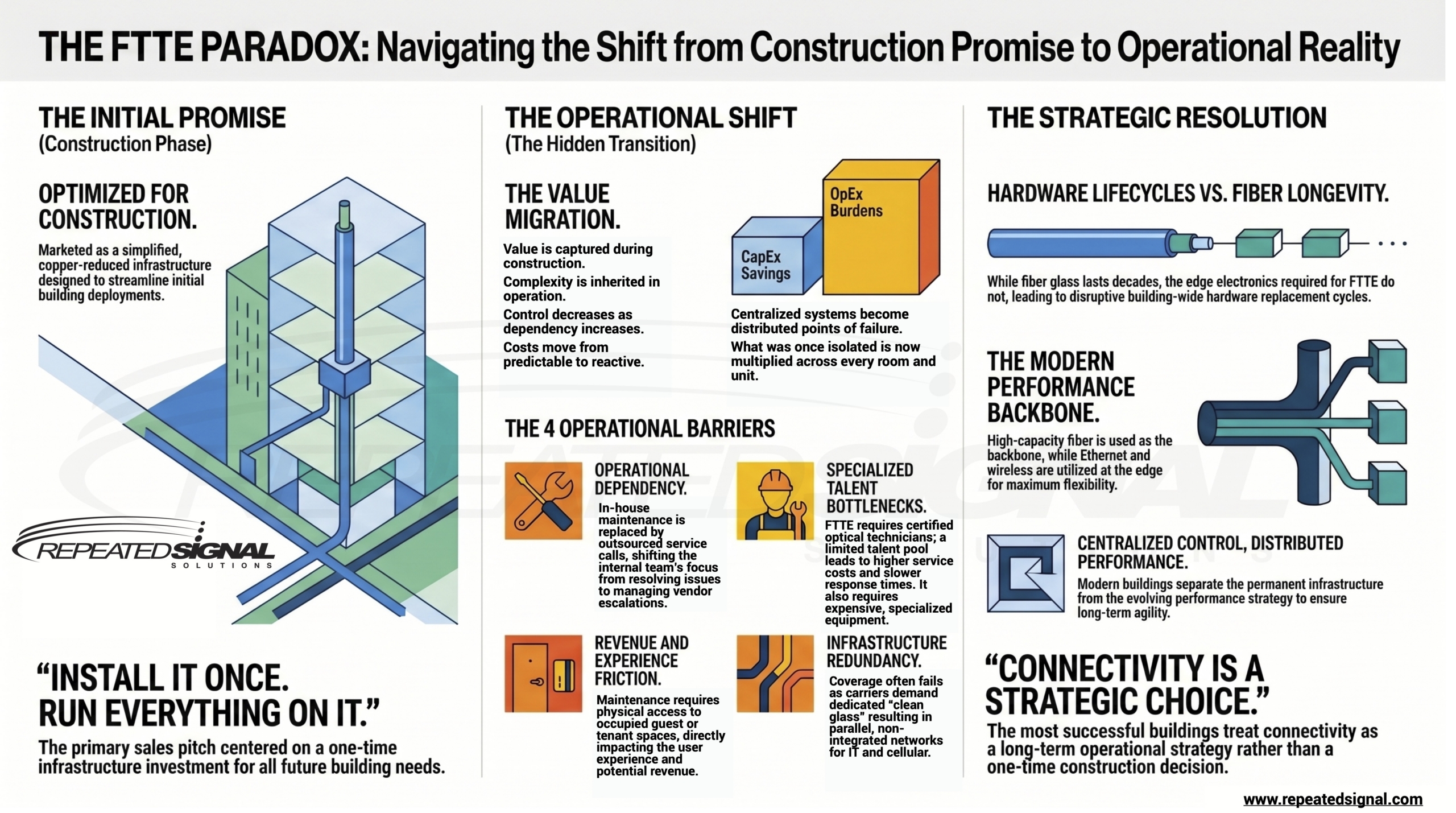
On paper, during the construction phase, the math looked undeniable. You save on conduit space, you reduce the cooling requirements of IDF closets, and you walk away with a “state-of-the-art” label. But as we move into 2026, the industry is waking up to a brutal reality. FTTE was optimized for the construction phase—but its long-term operational implications were not always fully aligned with the needs of ownership and property teams.
We have traded a manageable cabling standard for a decentralized operational model that increases complexity, specialized labor dependency, and long-term service, that is bleeding OpEx through specialized labor, vendor lock-in, and service disruptions.
What was positioned as a construction efficiency ultimately shifted cost into operations—where it becomes harder to control, harder to predict, and more expensive to manage over time.
The Hospitality Proof: Why High-Performance Operators Moved in a Different Direction
If FTTE were the gold standard for high-performance environments, the most operationally demanding and margin-sensitive organizations in the world would have standardized it years ago.
They didn’t.
Instead, what we’ve seen across large-scale hospitality portfolios is a clear divergence. Operators managing tens of thousands of rooms and endpoints prioritized one thing above all else: uptime and guest experience. And that requires infrastructure that is simple to operate, fast to troubleshoot, and flexible under constant change.
Embedding proprietary active electronics inside guest room walls introduced a different kind of risk—one tied not to installation, but to long-term operations. What looked efficient during construction became more complex to manage at scale.
Rather than leaning further into that model, the industry shifted its focus. High-density Wi-Fi, cloud-managed multi-gig Ethernet, and Passpoint-enabled strategies became the foundation. Not because they were newer—but because they aligned with how these organizations actually run their properties.
The priority wasn’t just performance. It was control.
A “Single Pane of Glass” approach to network management allows in-house IT teams to diagnose and resolve issues in minutes, without relying on specialized field support. That operational speed matters far more than theoretical infrastructure efficiency.
The result is a quiet but important reality: The most demanding environments in hospitality did not standardize around FTTE—not because fiber isn’t valuable, but because the way it was applied didn’t align with how these assets operate over time.
The Accountability Gap and the Cost of the Truck Roll
The most overlooked cost of FTTE isn’t hardware—it’s the loss of internal control.
In a traditional Ethernet environment, most issues can be handled in-house. A building engineer with basic tools can isolate and resolve a problem quickly, often without ever escalating beyond the property team.
That changes the moment active electronics move to the edge.
With the Optical Network Terminal deployed in ceilings, walls, or within tenant spaces, troubleshooting shifts into a different category entirely. When that fiber endpoint goes dark, it’s no longer a simple fix—it becomes a specialized service event.
Now you’re calling in a certified technician equipped with optical test gear, fusion splicing tools, and the expertise required to work on fiber infrastructure. In today’s market, those service calls typically range from $125 to $200+ per hour, often with multi-hour minimums and extended response times depending on availability.
The issue isn’t just cost—it’s dependency.
What was once an immediate, in-house resolution becomes an outsourced process with scheduling delays, access coordination, and limited control over response time. The building team no longer owns the fix. They manage the escalation.
The challenge is compounded by a constrained labor pool. GPON and FTTE systems rely on specialized optical skillsets and vendor-specific certifications that are not widely available at the property level. As a result, even routine issues can depend on external resources with limited availability—extending response times and increasing reliance on third-party support.
Over time, that shift creates an accountability gap—one where uptime is no longer directly controlled by the property, but by a third-party ecosystem operating on its own timeline.
The Hidden Cost of Intrusion: When a Network Failure Becomes a Revenue Event
In commercial and hospitality environments, there’s a cost few developers model upfront: the operational impact of entering a private space to fix infrastructure.
Traditional IDF-based networks are designed to keep most maintenance and troubleshooting confined to back-of-house areas. Issues can typically be addressed in a hallway closet or telecom room—without ever involving a guest or tenant.
FTTE changes that dynamic entirely.
Because the ONT is deployed at the edge, inside the room or unit, even a routine hardware issue can require physical access to an occupied space. What would have been a contained maintenance task becomes a coordinated service event.
In a hospitality setting, that shift carries real consequences.
A hardware failure is no longer just a ticket—it becomes a revenue disruption event. Gaining access to a guest room introduces delays, operational friction, and, in many cases, forces the room temporarily out of service. In high-end environments, that translates directly into lost RevPAR and, more importantly, a compromised guest experience.
The impact isn’t isolated to a single incident. Over time, the combination of access coordination, guest disruption, and service delays creates a layer of operational cost that is rarely visible during design—but becomes unavoidable in operation.
And that’s where the equation changes. What initially appeared as a construction efficiency begins to carry an operational burden—one that, over the life of the asset, can outweigh any upfront savings.
The Carrier Reality: Why Converged Fiber Breaks Down
Developers were promised that a single fiber backbone could support everything—from IT systems to cellular coverage. In practice, that assumption breaks down quickly when it meets carrier requirements.
Major operators like AT&T, Verizon, and T-Mobile do not rely on shared, owner-managed networks such as GPON to transport their RF signals. Not because they reject fiber—but because they require dedicated, point-to-point infrastructure that guarantees performance, security, and operational control.
Cellular networks are highly sensitive to latency, timing, and interference. Shared optical architectures introduce variability that falls outside carrier design standards. As a result, carriers insist on their own transport paths—often described as “clean glass”—that remain isolated from enterprise traffic. This isn’t a rejection of fiber—it’s a requirement for dedicated, deterministic transport that aligns with carrier-grade performance standards.
The outcome is not convergence, but separation.
Owners who deployed FTTE for building systems often find themselves installing a second, parallel network to support cellular DAS. What was intended to simplify infrastructure instead creates duplication—one network for IT operations, and another for carrier-grade wireless.
The lesson isn’t that fiber is the problem. It’s that not all fiber networks are designed to support all applications.
Obsolescence Is Not a Software Patch
The term “future-proof” was central to how FTTE was positioned to developers. The premise was simple: install fiber once, and the building is set for decades.
That narrative focused on the durability of the glass.
It largely ignored the reality of everything attached to it.
While fiber itself may last 20 to 30 years, FTTE architectures place active electronics at the edge—inside rooms, units, and tenant spaces. Those devices don’t follow a 30-year lifecycle. They follow the pace of technology, and that pace is accelerating.
We’re already seeing deployments from just a few years ago reaching their limits. As buildings push toward multi-gig Wi-Fi, AI-driven applications, and higher-density user demand, the constraint isn’t the fiber—it’s the endpoint.
And that’s where the model breaks.
Upgrading performance in these environments isn’t a centralized adjustment. It’s a distributed event. Every ONT becomes a dependency. Every room becomes a touchpoint. What was framed as a simple upgrade path turns into a building-wide hardware replacement cycle.
This isn’t a firmware update.
It’s a lifecycle CapEx event.
The Real Cost of Infrastructure is Measured Over the Life of the Asset—Not the Build
The issue isn’t that the technology was wrong. It’s that the lifecycle implications weren’t fully aligned with how buildings operate over time. The assumption that edge-based electronics could scale indefinitely without disruption has proven difficult to sustain in real-world environments.
That’s why the market is evolving.
Newer approaches are keeping fiber where it performs best—as a high-capacity backbone—while re-centralizing intelligence and power in locations that are accessible, serviceable, and adaptable. The goal isn’t to abandon fiber. It’s to apply it in a way that aligns with operational reality.
The buildings that get this right won’t just have better networks—they’ll have better control over cost, performance, and long-term asset value.
RSS works with developers and ownership teams to align connectivity strategy with performance, control, and lifecycle cost—before those decisions become permanent.