Why Owners and Developers Can No Longer Treat Connectivity as a “Nice to Have”
In today’s buildings, wireless infrastructure has quietly crossed a line. It is no longer a tenant amenity or IT layer—it is now a core operational system.
From casinos and financial institutions to hospitality, healthcare, and large-scale commercial developments, properties depend on uninterrupted wireless connectivity to support revenue, safety, and day-to-day operations.
When it fails, the impact is immediate—and increasingly, it’s not just operational. It’s regulatory.
At Repeated Signal Solutions (RSS), we see a consistent pattern across portfolios: wireless infrastructure is one of the most underestimated sources of operational and compliance risk inside modern buildings.
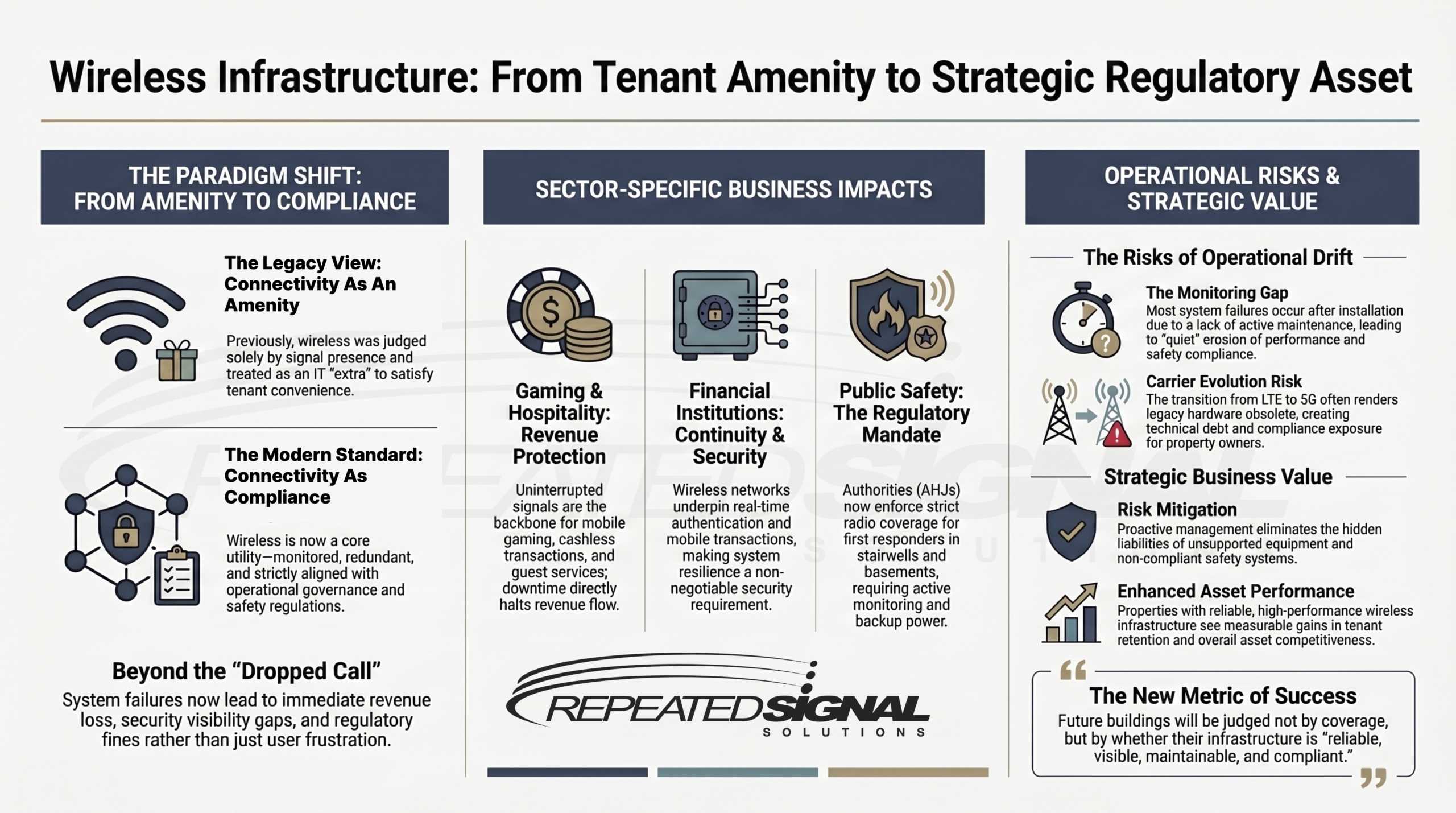
The Shift: From Coverage to Compliance
For years, wireless systems were judged by a simple question: “Do we have signal?”
That standard no longer holds.
Today’s environment demands that wireless infrastructure aligns with broader operational requirements—public safety communications, carrier performance expectations, system monitoring, and long-term maintainability. In many cases, these expectations are being enforced through regulation, inspection, and operational governance.
What used to be an IT conversation is now closer to fire life safety, security systems, and critical utilities.
And when something goes wrong, the consequences extend far beyond dropped calls.
Where the Risk Shows Up First: High-Stakes Environments
Gaming & Hospitality: Revenue Is Directly Tied to Connectivity
Few environments make this clearer than casinos and large hospitality properties.
These properties now rely on wireless infrastructure to support mobile gaming, cashless transactions, security coordination, guest services, and emergency communications—all operating simultaneously in dense, complex environments.
When wireless performance degrades, the impact is immediate:
- Transactions fail
- Guest experience declines
- Security and operations lose visibility
- Emergency communications can be compromised
In these environments, wireless infrastructure isn’t supporting the business—it is the business.
Financial Environments: Continuity and Security Are Non-Negotiable
In financial institutions and enterprise campuses, the stakes shift from revenue to continuity and security.
Wireless networks now underpin mobile transactions, real-time communications, authentication systems, and operational coordination. Any failure raises immediate questions around resilience, monitoring, and system accountability.
Executives are no longer asking if wireless works—they’re asking whether it’s:
- Monitored
- Redundant
- Aligned with current standards
- Capable of supporting emergency response
Those questions are becoming part of compliance—not preference.
Public Safety: The Line You Can’t Afford to Miss
One of the most significant changes in recent years is the enforcement of public safety communication systems—commonly known as ERRCS or public safety DAS.
Authorities Having Jurisdiction (AHJs) now require reliable radio coverage for first responders throughout a building, including areas historically ignored: stairwells, basements, parking structures, and mechanical spaces.
This isn’t a one-time inspection. It’s an ongoing obligation.
Buildings are now expected to maintain:
- Verified coverage performance
- Backup power systems
- Active alarm monitoring
- Documented testing and maintenance records
What we see too often is systems that technically exist—but are no longer compliant. Unsupported equipment, lack of monitoring, and poor maintenance create exposure that only becomes visible during inspection—or worse, during an emergency.
Carrier Evolution Is Forcing a Second Wave of Risk
At the same time, mobile carriers continue evolving their networks—from LTE to 5G and beyond.
That evolution creates a quiet but critical issue: many existing systems were never designed to keep up.
Legacy infrastructure may no longer support new frequencies. Hardware reaches end-of-life. Monitoring expectations increase. And what once “passed” a coverage test may no longer meet operational expectations.
This is where many properties get caught off guard.
Wireless infrastructure is not static—it requires lifecycle management, coordination with carriers, and a plan for modernization.
Without that, performance—and compliance—drift over time.
The Biggest Gap: What Happens After Installation
The most common failure point isn’t design. It’s what happens after the system goes live.
Historically, wireless infrastructure has been deployed and left alone—no monitoring, no maintenance strategy, no accountability. Over time, systems degrade, alarms go unnoticed, and performance quietly erodes.
In regulated environments, that’s no longer acceptable.
Wireless infrastructure now needs to be treated like any other critical building system:
- Continuously monitored
- Actively maintained
- Supported with clear escalation paths
- Managed over its full lifecycle
Anything less introduces risk that compounds over time.
Compliance Is Also a Business Decision
Beyond regulation, there’s a second layer to this conversation: experience.
Tenants, guests, and customers now expect seamless connectivity everywhere. When it fails, it impacts perception, retention, and ultimately revenue.
Properties that invest in reliable, well-managed wireless infrastructure are seeing measurable advantages—not just in risk reduction, but in asset performance and competitiveness.
This is where compliance and experience intersect.
A Different Way to Think About Wireless Infrastructure
At RSS, we approach wireless infrastructure as operational infrastructure—not a one-time construction scope.
That means designing, supporting, and maintaining systems with the expectation that they must perform continuously, adapt over time, and withstand regulatory scrutiny.
Because the reality is simple:
The next generation of buildings won’t be judged by whether they have wireless coverage.
They’ll be judged by whether that infrastructure is reliable, visible, maintainable, and compliant.
The Bottom Line
Wireless infrastructure has become one of the most critical—and most overlooked—systems inside modern buildings.
The conversation is no longer:
“Do we have coverage?”
It’s:
“Is our infrastructure compliant, supportable, and ready for what’s next?”