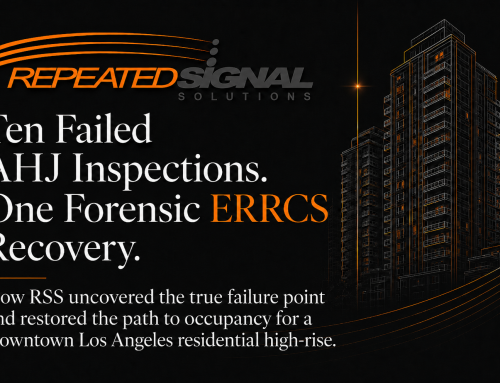
A forensic public-safety communications audit turned repeated AHJ failures into a controlled path to approval, occupancy, and tenant confidence.
Project Type:
Residential High-Rise
Downtown Los Angeles, California
System Type:
ERRCS / Public Safety Radio Communications System
Forensic Audit, Failure Diagnosis, and Remediation Strategy
The Challenge: A High-Rise at Risk of Losing Occupancy Momentum
A newly constructed residential high-rise in Downtown Los Angeles was facing a critical life-safety communications failure. The building had failed multiple AHJ ERRCS acceptance tests throughout the property, creating a serious risk to final occupancy approval.
The situation had moved beyond a technical inconvenience. The owner was at risk of not receiving TCO, and prospective tenants were beginning to question whether the building would be ready for occupancy as promised.
The existing system presented a confusing and dangerous contradiction: the original integrator’s testing indicated that RF was present, yet LAFD testing showed repeated failures, including non-functional uplink performance in critical areas. Several spaces could not even be properly evaluated because stairwell and vestibule failures prevented the testing sequence from advancing.
For the owner, the problem was simple: the building had an installed ERRCS system, but it did not have an approved, functioning life-safety communications network.
The RSS Approach: Treat the Failure Like a Forensic Investigation, Not a Coverage Complaint
RSS was brought in to determine why the system continued to fail and to establish a remediation strategy that avoided unnecessary capital upgrades.
The first priority was to move past surface-level assumptions. This was not treated as a basic “low signal” issue. RSS approached the project as a forensic failure investigation, reviewing the BDA, fiber-fed remote architecture, RF path, system configuration, fire-alarm interface, and field performance conditions.
The goal was to identify the actual root cause before recommending any expansion, replacement, or redesign.
What RSS Found
A Critical Fiber-Fed Remote Was Not Functioning
RSS identified a patch-panel fault that prevented RF from reaching a key coverage layer of the system.
As a result, an entire antenna zone was effectively radiating no usable signal. On paper, the system appeared to include the required infrastructure. In the field, a major layer of the building was not actually contributing to public-safety coverage.
The Headend Was Incomplete
RSS also discovered that the headend architecture was incomplete for the required life-safety application.
The system was missing a proper Point of Interface, creating risk of front-end overload and system clamping. It was also missing the required controller module for fire-alarm supervision, meaning the ERRCS system was not properly reporting critical supervisory conditions to the fire alarm panel.
This created two major risks:
- The RF platform was vulnerable to improper input levels and performance instability.
- The life-safety system was not fully supervised as required for emergency communications infrastructure.
The Original Design Relied Too Heavily on Passive Distribution
The system had been designed around a passive-only distribution approach for a high-rise environment.
That strategy may show RF presence in certain areas, but it does not automatically support the uplink performance required for reliable public-safety radio communications. In an ERRCS environment, downlink signal alone is not enough. Firefighters must be able to transmit back through the system from critical areas of the building.
The failure was not simply about whether signal existed. The issue was whether the system had an engineered, validated signal path that supported both downlink and uplink communications under AHJ testing conditions.
The BDA Configuration Could Not Be Trusted Without Verification
RSS also identified uncertainty around the BDA configuration, including the possibility that the system was operating on incorrect or incomplete frequency parameters.
For a public-safety system, this is a major concern. ERRCS performance depends on proper frequency configuration, RF input management, system gain control, supervision, and acceptance testing against the actual requirements of the responding agency.
Why the System Failed
The building did not fail because it simply needed “more signal.”
It failed because the system did not have a fully engineered and commissioned public-safety communications path, particularly on the uplink side.
The installed infrastructure gave the appearance of a complete ERRCS system, but RSS found that key components were not functioning, the headend was incomplete, the RF path had not been fully validated, and life-safety supervision had not been properly restored to the fire alarm system.
In practical terms, the building had equipment in place, but the system was not yet operating as an AHJ-ready emergency communications network.
The RSS Remediation Strategy
RSS developed a forensic, sequence-driven recovery plan designed to isolate root cause before forcing the owner into unnecessary upgrades.
The remediation strategy included:
- Full invasive system audit at the BDA and fiber layer
- Verification of actual RF input, signal path, and system configuration
- Protection and proper configuration of the ION-B platform
- Restoration of fire-alarm supervision
- Performance testing using real 5-watt public-safety radios
- Targeted coverage augmentation only where required
This disciplined approach helped prevent premature system replacement and avoided unnecessary capital spend before the true failure points were understood.
The Outcome: From Repeated Failure to AHJ Acceptance
RSS converted a non-diagnosable system failure into a controlled engineering recovery process.
The owner avoided a premature full system replacement, the true failure points were identified, and the ERRCS platform was brought back onto a viable path for AHJ approval.
Most importantly, the building ultimately passed AHJ inspection, allowing TCO to be granted and removing a major life-safety and occupancy obstacle for the project.
Key Takeaway
Installed Equipment Does Not Equal an Approved ERRCS Network
This project demonstrates one of the most common risks in public-safety communications: a building can have ERRCS equipment installed and still fail acceptance if the system has not been properly engineered, configured, supervised, and validated.
For owners and developers, the difference matters.
An ERRCS system is not just a collection of BDAs, remotes, fiber, antennas, and passive components. It is a life-safety communications network that must perform under real AHJ testing conditions, with reliable uplink and downlink performance in the areas first responders depend on most.
RSS helps owners move beyond guesswork, isolate true failure points, and recover troubled systems before unnecessary replacement costs, occupancy delays, or tenant impacts escalate.