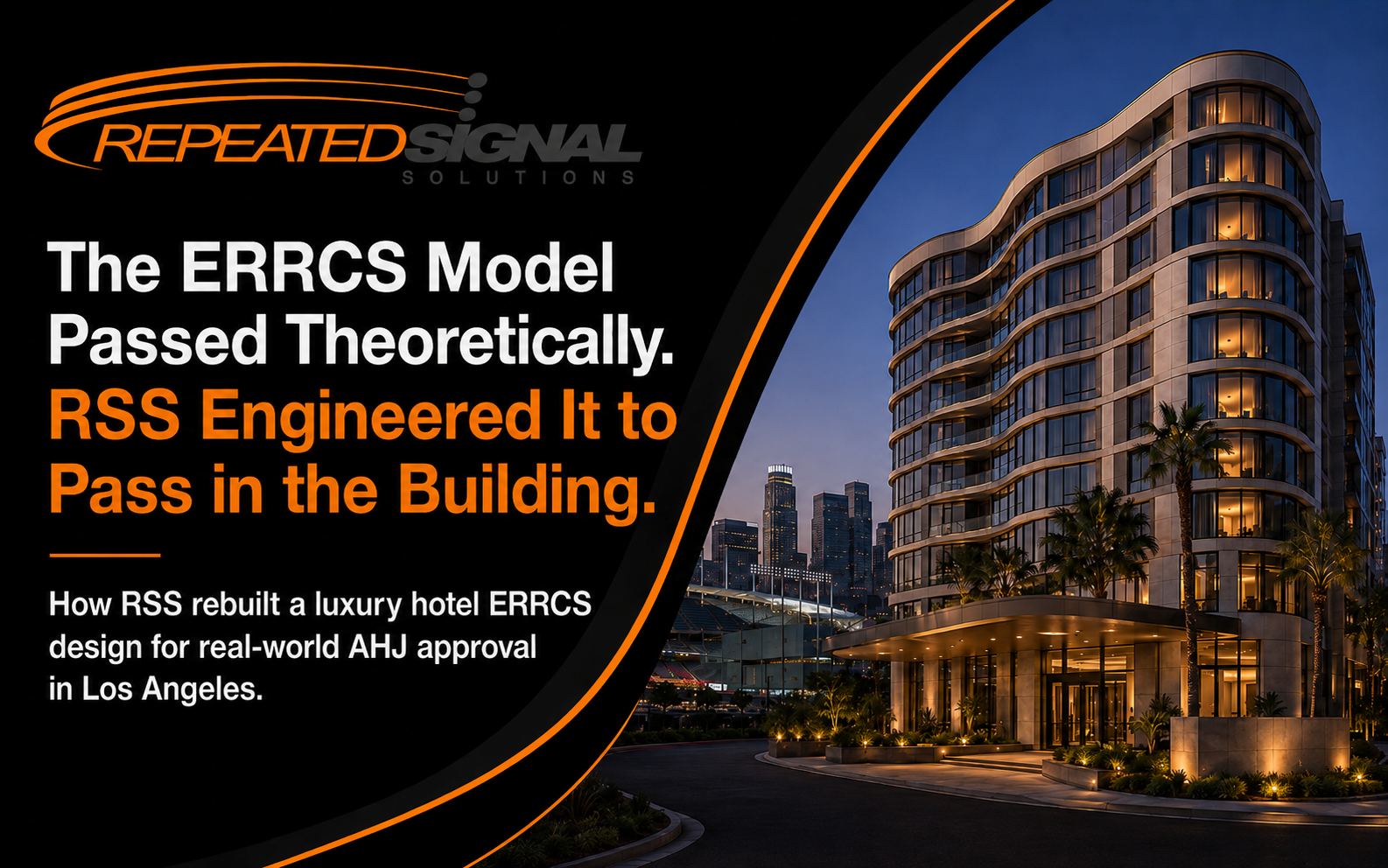
How RSS reconstructed a pre-construction ERRCS model, corrected optimistic RF assumptions, reduced visual impact, and improved the path to first-time AHJ approval for a luxury hotel in Los Angeles.
Project Type
Luxury Hotel
Los Angeles, California
System Type
ERRCS / Public Safety Radio Communications
Pre-Construction RF Reconstruction, Compliance Validation, and Architectural Optimization
The Challenge: A Public-Safety Design That Needed to Perform in the Real Building
A luxury hotel project in Los Angeles required a code-compliant ERRCS / public-safety communications system capable of passing final acceptance by the Authority Having Jurisdiction.
At the request of the ownership and project team, RSS performed an independent, performance-based engineering review of the proposed ERRCS design before construction. The goal was not simply to review whether the design appeared acceptable in software. The real question was whether the system would perform inside the actual building, under real AHJ test conditions, after construction was complete.
That distinction mattered.
The original design showed coverage levels that appeared compliant, but RSS identified that the model relied on optimistic RF assumptions. Those assumptions created a common project risk: a system that passes in software but fails in the building.
For an operating luxury hotel, that kind of failure can become extremely expensive. It can lead to post-construction antenna additions, ceiling demolition, finished-space rework, schedule delays, change orders, and a difficult AHJ approval process.
RSS was brought in to determine whether the system could pass first-time acceptance testing and whether the design could be improved architecturally and financially without reducing life-safety performance.
The RSS Approach: Rebuild the Model Around Reality, Not Optimism
RSS did not accept the original coverage plots at face value.
Instead, RSS rebuilt the RF model from the ground up using the same methodology it applies when responsible for delivering ERRCS systems that must pass AHJ testing on the first inspection.
The reconstructed model included actual building construction assemblies, correct material attenuation values, real antenna elevations, code-compliant public-safety equipment parameters, and worst-case signal-loss assumptions.
That process changed the focus from theoretical coverage to field performance.
The purpose was simple: determine how the system would actually behave in the completed hotel, not how it appeared in an optimistic design model.
What RSS Found:
The Original Model Relied on Optimistic RF Assumptions
RSS found that the original model produced coverage levels that appeared compliant because it relied on reduced wall-loss assumptions, reduced path-loss conditions, and non-worst-case signal environments.
Those assumptions can make a design look cleaner, less expensive, and easier to approve during the design phase. But they also create a dangerous gap between predicted performance and actual field performance.
In public-safety communications, the AHJ does not approve a system based on how good the model looks. The system must work in the building during acceptance testing.
RSS identified that the original model carried a real risk of appearing compliant in software while failing once measured in the finished property.
The Antenna Platform Created Unnecessary Architectural Impact
The original design specified large-format antennas mounted below the ceiling plane.
For a luxury hospitality environment, that created an unnecessary visual issue. Below-ceiling antennas can disrupt the architectural finish, create aesthetic objections, and reduce design flexibility in public spaces, corridors, and guest-facing areas.
RSS determined that the specified antenna platform did not provide a meaningful RF performance advantage for the required public-safety bands.
That created an opportunity to improve the design without sacrificing compliance.
RSS Identified a Lower-Profile Antenna With No Performance Trade-Off
RSS replaced the originally specified antenna with a low-profile wideband antenna and revalidated performance in the reconstructed RF model.
The replacement antenna met the required gain and radiation characteristics for the applicable public-safety bands. It also maintained life-safety coverage levels in the revised model.
The antenna was already deployed on the same public-safety network serving a major nearby sports venue, which further supported its suitability for the local operating environment.
The result was clear: RSS was able to improve the architectural condition without reducing RF performance.
The revised antenna offered a 0.30-inch profile, flush ceiling integration, a paintable enclosure, and the ability to mount directly to hard ceilings or ceiling tile.
For the hotel, that meant the ERRCS infrastructure could be better integrated into the architectural environment while preserving the life-safety performance requirement.
The Antenna Change Also Reduced Material Cost
The architectural improvement also created a financial benefit.
Across 131 antennas, the original antenna material cost was approximately $30,020 based on MSRP-level pricing. The revised antenna material cost was approximately $11,208.
That represented an estimated material cost reduction of approximately $18,800.
This is a key point for owners and developers: better engineering does not always mean higher cost. In this case, RSS improved the architectural outcome, preserved RF performance, and reduced material cost at the same time.
The Building Model Needed Real Construction Data
RSS found that the original model assumed lower signal loss through walls, structural assemblies, and floor separations.
Those assumptions artificially improved predicted coverage.
RSS corrected the model using actual wall types, real thicknesses, correct material loss factors, and true signal propagation paths. The revised model produced lower signal levels, but those signal levels were accurate.
That is exactly what a public-safety communications design should do.
A model that shows inflated coverage can create a false sense of security. A model that reflects the real building gives the project team the information needed to pass inspection and avoid rework.
The Design Needed to Align With Worst-Case AHJ Test Conditions
RSS also adjusted the signal assumptions to reflect the conditions under which the system would actually be tested.
The original model assumed lower occupancy loading, reduced path loss over distance, and minimal environmental degradation. Those assumptions increased predicted coverage without increasing real performance.
RSS revised the model to reflect occupied building conditions, maximum code-required path loss, and conservative uplink and downlink balance.
That matters because public-safety radio systems must perform when the building is occupied, doors are closed, and attenuation is at its most challenging. AHJ grid testing is not based on ideal conditions. It is based on whether first responders can communicate reliably in the real environment.
The RSS model aligned the design with those conditions before construction.
The RSS Engineering Solution
RSS converted the original design from a visually compliant software model into a field-verifiable ERRCS solution.
The redesigned approach included:
- A reality-based RF model using actual construction conditions
- Correct material attenuation and propagation assumptions
- Worst-case signal-loss design criteria aligned with AHJ testing
- A low-profile, flush-mounted antenna platform suited for luxury hospitality
- Validated RF performance with no life-safety trade-off
- Reduced antenna material cost
- Improved architectural integration
The result was a public-safety design that protected the approval path while improving the built environment.
The Outcome: Better Compliance, Better Architecture, Lower Material Cost
RSS delivered a pre-construction redesign that improved the project across four critical areas.
From a life-safety standpoint, the revised design aligned the ERRCS system with code-compliant performance and first-time acceptance-test expectations.
From an architectural standpoint, the large below-ceiling antennas were replaced with a flush, paintable antenna platform that better matched the expectations of a luxury hotel environment.
From a financial standpoint, the antenna change reduced estimated material cost by approximately $18,800 while avoiding the much larger potential cost of post-construction rework.
From a technical standpoint, the revised model provided a reality-based RF performance prediction using actual construction conditions and worst-case test assumptions.
The original design was built around a model that appeared compliant in software.
RSS engineered the system to pass in the building.
Key Takeaway
ERRCS Approval Is Won in the Field, Not in the Coverage Plot
This case study demonstrates why pre-construction RF validation is so important for hotels, high-rises, venues, and complex mixed-use projects.
A predictive model can make a system appear compliant if the assumptions are optimistic enough. But AHJ approval is based on measured performance inside the finished building. If the model does not reflect real construction assemblies, real attenuation, antenna elevations, and worst-case path loss, the project team may not discover the problem until ceilings are closed, finishes are complete, and the building is trying to move toward occupancy.
That is when ERRCS failures become expensive.
RSS helps owners and project teams identify those risks before construction, when the system can still be corrected without demolition, schedule damage, or change-order escalation.
In this project, RSS did more than identify risk. RSS improved the design, protected life-safety performance, reduced visual impact, and lowered material cost.
That is the value of performance-based ERRCS engineering.