RSS warned them before construction.
They built it anyway.
Then they rejected the fix as too expensive.
Project Type
Luxury Hotel
West Hollywood, California
System Type
Cellular DAS + ERRCS / Public Safety Radio Communications
Design Risk Review, RF Modeling Audit, Code Compliance Review, and Remediation Roadmap
The Challenge: A Luxury Hotel Built Around a Wireless Design RSS Had Already Flagged
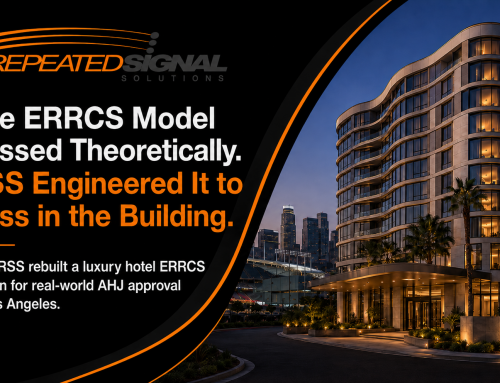
A luxury hotel in West Hollywood required both in-building cellular coverage and a code-compliant ERRCS / public-safety communications system. For a property of this caliber, wireless performance was not a minor technical detail. It directly affected guest experience, staff operations, carrier connectivity, emergency responder communications, and brand perception.
RSS was initially engaged before construction to review the proposed iBwave design for the building’s Cellular DAS and ERRCS systems. That review identified major design, performance, compliance, and life-safety deficiencies before the system was ever built.
The findings were not speculative. RSS identified problems in the RF model, antenna spacing, compliance criteria, carrier assumptions, and public-safety scope. RSS also provided the corrective direction required to give the system a realistic path to cellular performance, AHJ acceptance, and post-construction compliance.
The ownership and hotel management teams elected not to implement those recommendations.
The project proceeded with the original flawed design.
After the hotel opened, the issues RSS had warned about became real. The property experienced poor cellular coverage, dropped calls, and inconsistent user experience. RSS was later re-engaged to review the final as-built iBwave design and determine why the system was failing in operation.
The as-built review confirmed the central issue: the system had been constructed with the same deficiencies RSS had already identified before construction.
RSS was then asked to provide a remediation path and pricing to correct the system.
That corrective scope was rejected as too expensive.
The RSS Approach: Compare the Original Warning Against the Final As-Built System
RSS approached the project as a design accountability and recovery review.
The objective was not simply to identify where signal was weak. The deeper question was whether the system had ever been properly engineered to deliver the required outcome.
RSS reviewed the original design assumptions, the final as-built documentation, cellular DAS modeling criteria, ERRCS scope, RF propagation methodology, antenna layout, carrier band strategy, and available validation data.
The review confirmed that the original design deficiencies remained in the final constructed system. No meaningful corrective changes had been made to address the issues RSS had identified before construction.
Because no usable post-installation indoor walk-test data was available, RSS developed a detailed floor-by-floor, band-by-band remediation roadmap to define what would be required to recover the system.
What RSS Found:
The ERRCS Scope Was Not Code-Complete
RSS identified that the public-safety communications scope excluded several elements required for a code-compliant ERRCS system.
The missing scope included fire alarm panel integration, an annunciator, battery backup, and third-party validation testing.
These are not optional enhancements. They are core requirements for AHJ approval, life-safety supervision, and emergency responder communications operation.
Without those elements, the system could not be treated as a complete public-safety communications solution.
The RF Model Did Not Reflect the Real Building
The RF model included only a portion of the actual walls in the hotel. RSS identified that approximately 40% of the walls were represented in the model, meaning the propagation results were artificially inflated.
That matters because luxury hotel construction is dense. Guest rooms, corridors, service spaces, elevators, concrete, steel, back-of-house areas, and amenity spaces all create real attenuation.
When the model omits those barriers, the predicted coverage looks stronger than the installed system can actually deliver.
In this case, the design appeared more compliant on paper than it could ever be in the real building.
The Cellular Antenna Spacing Was Too Wide for the Environment
RSS found that cellular antennas were spaced approximately 150 feet apart.
That spacing was not consistent with high-band cellular propagation, dense hotel construction, or modern carrier performance expectations.
In a luxury hotel, guests expect reliable service in rooms, corridors, restaurants, lounges, meeting areas, amenity spaces, elevators, and back-of-house zones. Wide antenna spacing may reduce construction cost, but it also increases the probability of weak signal, poor SINR, dropped calls, and inconsistent data performance after opening.
The design overstated high-band coverage and created a predictable post-installation performance problem.
The Compliance Criteria Were Reduced Below Real Acceptance Expectations
The design used an 85% coverage threshold as the compliance basis.
That was a major issue. Real-world carrier and code-driven performance targets require a much stronger standard, commonly aligned around 95% coverage depending on system type, jurisdiction, and carrier requirements.
Even under the reduced 85% threshold, many bands still did not pass.
RSS identified examples where performance results showed 90% coverage at -95 dBm and 94% coverage at -105 dBm. Under real acceptance criteria, those results were still not compliant.
This meant the design was not only using a weakened compliance target; it was still failing in key areas even against that lower standard.
The Design Used Outdated and Incorrect Technology Assumptions
RSS also identified technology and spectrum errors in the model.
The design included EVDO for AT&T, even though that was not a current or appropriate AT&T technology basis for the project.
That pointed to a likely template-based model, outdated RF database, or lack of carrier-aligned engineering.
For a carrier-facing DAS, that is a serious problem. The system must be designed around current carrier spectrum, current deployment standards, and realistic band support.
When outdated technologies or incomplete band assumptions appear in the model, the owner should question whether the system is truly engineered for the carriers it is expected to support.
Carrier Band Support Was Incomplete
RSS found that only Verizon 2100 MHz compliance values were shown in the design documentation. Other bands did not include compliance data.
That omission created concern that additional bands may have been left out because they did not pass.
In a multi-carrier hotel environment, selective reporting is not enough. Owners need to know whether all intended carriers and bands can meet the required performance criteria across the property.
A DAS that only demonstrates partial band compliance is not a fully validated multi-carrier solution.
The Cellular Strategy Created Post-Deployment Risk
The system relied on a donor-signal-based cellular strategy to deliver high-band performance and guest experience.
That approach created additional risk because the design did not fully account for actual macro conditions present at the site. For example, strong AT&T 2300 MHz macro signal was present but not captured in the design.
That mismatch can create unpredictable user experience after installation. If the model does not reflect the real RF environment around the building, the system may struggle with donor signal behavior, band availability, optimization risk, and inconsistent carrier performance after opening.
There Was No Usable Indoor Validation Data
RSS found that only outdoor “snail trail” data was available.
There were no usable indoor validation walks and no floor-by-floor signal verification data that could confirm how the installed system was actually performing inside the hotel.
That left the ownership team without the field data needed to isolate failures, validate assumptions, or confirm whether the installed system could be corrected without significant reconstruction.
For an operating luxury hotel, that lack of validation data is a major problem. Without real indoor performance data, the team is forced to rely on models, assumptions, and guest complaints instead of measured system behavior.
The RSS Remediation Roadmap
Because usable post-installation walk-test data was not available, RSS developed a detailed Excel-based remediation roadmap.
The roadmap quantified the corrective work required on a floor-by-floor and band-by-band basis. It identified the required antenna density, active equipment capacity, proper band support per carrier, link-budget balancing, and the full code-required public-safety scope.
This was not a conceptual recommendation. RSS converted the failed system review into a construction-ready recovery plan capable of delivering a functional and compliant cellular and public-safety communications system.
The remediation roadmap gave the ownership and hotel management teams a clear path to recover the investment, correct the design failures, and move the system toward real performance.
That corrective scope was rejected as too expensive.
Root Cause: The Project Proceeded With a Known Defective Design
The root cause was not an unknown field condition, an unexpected construction issue, or a mystery performance failure.
The root cause was that the project moved forward with a design RSS had already identified as deficient before construction.
The original design reduced cost by omitting key performance and compliance elements. The RF model did not reflect the actual building environment. Antenna spacing was too wide for a dense luxury hotel. Compliance thresholds were reduced below real performance expectations. Required life-safety scope was excluded. Carrier spectrum assumptions were incomplete or outdated.
RSS identified those issues before the system was built and explained what needed to change.
Those corrections were not implemented.
When the hotel opened, the system performed exactly as the design review predicted: poor coverage, dropped calls, inconsistent user experience, and an infrastructure platform that could not meet the intended standard without significant corrective work.
The Outcome: A Preventable Failure Became a Costly Recovery Decision
RSS identified the problems before construction and provided the corrective direction. The ownership and hotel management teams chose to proceed without making those changes.
After opening, the same issues appeared in real operation.
RSS was then brought back in to review the as-built system and confirmed that the original flaws had carried through into construction. No meaningful corrective changes had been made to the deficient design.
RSS developed the remediation path required to recover the system. That fix was later rejected because the cost was considered too high.
At that point, the project had already paid to build the wrong system once. The proper solution now required rebuilding portions of the infrastructure that could have been corrected before construction, before the hotel was operating, and before guest experience was being affected.
The result was a stranded wireless investment: infrastructure had been purchased and installed, but the system could not meet the intended performance level without reconstruction.
Key Takeaway
Ignoring the Right Diagnosis Does Not Avoid Cost. It Delays It.
This project demonstrates one of the most expensive mistakes an owner or hotel operator can make with in-building wireless infrastructure.
RSS identified the DAS and ERRCS problems before construction. The recommendations were not implemented. The hotel opened with the same deficiencies still in place. Once the system failed in operation, RSS confirmed through as-built review that the original flawed design had been carried into the final installation.
The required fix was then priced and rejected as too expensive.
That is the real lesson: the correct wireless solution may look expensive before construction, but it is almost always less expensive than opening a luxury property with a system that cannot perform, then trying to reconstruct it after guests, staff, operations, and brand expectations are already active.
For luxury hotels, DAS and ERRCS infrastructure should not be value-engineered below the performance requirement. The cost does not disappear. It comes back later as guest complaints, dropped calls, failed expectations, compliance exposure, and reconstruction cost.
RSS designs and reviews in-building wireless systems around real performance standards: full wall modeling, realistic high-band propagation, carrier-current spectrum data, proper compliance criteria, indoor validation, and code-complete public-safety scope.
The discipline costs more upfront because it reflects what the building actually requires.
But it is far less expensive than building the wrong system twice.
Project Timeline
2017 — Risk Identified
RSS completed the initial pre-construction engineering review and identified performance, compliance, and life-safety deficiencies.
2018 — Corrections Not Implemented
The project proceeded without incorporating the recommended design corrections.
2019 — System Operational Failure
After opening, the hotel experienced poor cellular coverage, dropped calls, and inconsistent user experience.
2019 — As-Builts Reviewed
RSS reviewed the final as-built iBwave design and confirmed the original deficiencies remained in the constructed system.
2019 — Remediation Fully Engineered
RSS developed a floor-by-floor, band-by-band remediation roadmap to recover the system.
2019 — Corrective Scope Rejected
The required fix was rejected as too expensive, leaving the installed system unable to meet the intended performance without reconstruction.